


HOME LATEST ISSUE
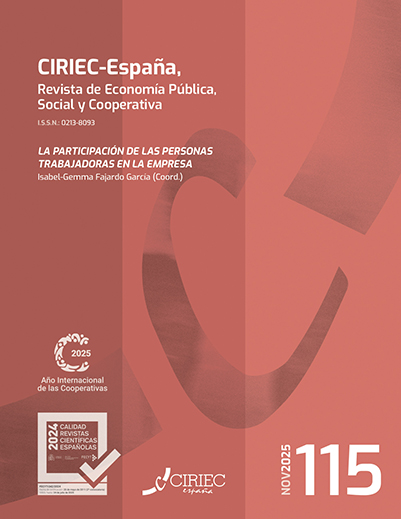
CIRIEC Nº 115 November 2025
Employee participation in the companies
Economic Democracy: companies´s engine in XXI century
Authors: Bruno Estrada López
Keywords: Economic democracy, workers participation, innovation-led economies, productivity. technological change, organizational capital.
Econlit Keywords: D23, J3, J24, J54, L2, O35
DOI: https://doi.org/10.7203/CIRIEC-E.115.30908
Abstract
The main characteristic of “innovation-led economies” is that new technologies, globalization, and the expansion of the service sector have turned unskilled labor into a secondary factor of production, giving prominence to talent.
Therefore, in “innovation-led companies,” i.e., those that are essentially composed of talent, from the perspective of economic efficiency itself, giving greater decision-making power to workers has positive effects, since collaboration in management between employers and unions improves the organizational capital of these companies. Workers are the first to be interested in maximizing their human capital, just as the shareholders were the most interested in maximizing the value of the capital stock of 20th-century Fordist companies.
In these highly productive and competitive economies, such as Germany and the Nordic countries, the fact that a greater balance in bargaining power between shareholders and workers has been maintained for decades, and that laws on worker participation in companies have been developed, has enabled workers to enjoy higher wages today. Therefore, the democratization of companies is also a powerful instrument for achieving more equal societies.
How to cite this article
ESTRADA LÓPEZ, Bruno (2025): “Economic Democracy: companies´s engine in XXI century”, CIRIEC-España, Revista de Economía Pública, Social y Cooperativa, 115, 15-37. DOI: https://doi.org/10.7203/CIRIEC-E.115.30908
Workers’ Participation in Firms and Economic Efficiency
Authors: Vicente Salas Fumás
Keywords: Labor participation, economic efficiency, codetermination, comparative analysis.
Econlit Keywords: J54, J83, M54, D23
DOI: https://doi.org/10.7203/CIRIEC-E.115.30947
Abstract
The text proposes a general framework for analyzing worker participation in companies and delves into the theory and evidence on the relationship between participation and economic efficiency (productivity and workers’ well-being). The selection of theory and evidence is biased toward economic research that evaluates the relationship between participation and efficiency when workers’ participation rights are established by legal mandate, using quasi-experimental research methods. The review of the selected research work suggests that labor participation/co-determination in countries where it is legally established does not substantially change power relations within companies, although it may marginally improve company performance and workers’ well-being due to the boost it provides to information exchange and cooperation, and through an increase in workers’ influence via greater autonomy in their work environment.
How to cite this article
SALAS FUMÁS, Vicente (2025): “Workers’ Participation in Firms and Economic Efficiency”, CIRIEC-España, Revista de Economía Pública, Social y Cooperativa, 115, 39-68. DOI: https://doi.org/10.7203/CIRIEC-E.115.30947
Horizontal management: Transcending the bureaucratic paradigm to consolidate worker participation
Authors: Alfonso Estragó
Keywords: Management, decisions, participation, horizontality, bureaucracy, paradigm.
Econlit Keywords: J54, J59, M19
DOI: https://doi.org/10.7203/CIRIEC-E.115.30948
Abstract
In general terms, the proposals that promote greater levels of democracy in organisations have as their main driving force the participation of workers in ownership or in strategical-institutional decision-making spaces. In this respect, it is possible to improve such proposals by including in the analysis other decision-making spaces of a more tactical and operational nature, which represent work spaces whose perceived proximity is very tangible to the typical worker. However, the bureaucratic-Weberian arrangement remains the universally used social technology for managing these organisational domains, which represents a limit to the deepening of workers’ participation in decision-making. On the other hand, despite the existence of several successful experiences of horizontal management, the shift towards a paradigm that transcends bureaucracy (while preserving all its virtues) is still distant because it requires -among other elements- an alternative theoretical corpus that gives academics and practitioners the necessary confidence to adopt it. In this sense, through an “integrative” literature review, the contribution of the article consists in outlining an academic narrative that provides theoretical foundations to explain, in a systematic and concise way, why horizontal management arrangements that depart from the bureaucratic mainstream appear to be stable, effective and efficient. In doing so, it aims to contribute to the consolidation of an alternative paradigm that promotes deeper worker participation in all organisational decision-making.
How to cite this article
ESTRAGÓ, Alfonso (2025): “Horizontal management: Transcending the bureaucratic paradigm to consolidate worker participation”, CIRIEC-España, Revista de Economía Pública, Social y Cooperativa, 115, 69-101. DOI: https://doi.org/10.7203/CIRIEC-E.115.30948
Co-management and cooperativism in christian thought. Case studies of different forms of participation
Authors: Borja Vivanco Díaz
Keywords: Co-Management, Cooperatives, Alternative economy, Cooperative enterprises, Forms of participation in enterprises
Econlit Keywords: N, O1, M5, P5
DOI: https://doi.org/10.7203/CIRIEC-E.115.30944
Abstract
The main objective of the article is to analyze various forms of participation in the economy and business that are rooted in Christian values, with the aim of demonstrating ways to integrate human dignity, social justice, and the common good into productive activity. The methodology used is a comparative study of four emblematic cases in different historical and geographical contexts. The case studies examined are: the Guaraní Reductions of the 17th and 18th centuries, a model of communal economy and indigenous co-management under Jesuit guidance; the German Co-Determination Law of 1951, which regulated equal participation of workers and capital in the boards of large industries; the Mondragon Group, a cooperative benchmark where workers are members/owners and manage democratically (“one person, one vote”); and the Economy of Communion (promoted by the Focolare Movement), which seeks to transform all types of businesses through a “culture of giving” and participatory management. The main contributions and conclusions of the article are that these experiences, despite their structural and contextual differences, share Christian principles, and demonstrate that worker participation is not merely an instrumental mechanism, but a space for ethics and social justice. They also show that workers can be active agents and protagonists, and that there are multiple valid models to humanize the economy and place it at the service of people.
How to cite this article
VIVANCO DÍAZ, Borja (2025): “Co-management and cooperativism in christian thought. Case studies of different forms of participation”, CIRIEC-España, Revista de Economía Pública, Social y Cooperativa, 115, 103-135. DOI: https://doi.org/10.7203/CIRIEC-E.115.30944
Labour participation in company boards in Spain: the fuse that has not lit
Authors: Sara Lafuente
Keywords: Worker participation, corporate boards, trade unions, state-owned companies, saving banks.
Econlit Keywords: K31, M12
DOI: https://doi.org/10.7203/CIRIEC-E.115.30998
Abstract
Spain could be considered one of those European countries where workers have participated with voting rights on boards of directors, judging by existing practices in public companies, based on a trade union participation agreement adopted in 1986, or in savings banks, whose governing bodies included employee participation before Law 31/1985 was repealed in 2013.
However, a more detailed analysis reveals how this type of participation could hardly take off as a system in either public companies or savings banks. It had little impact on the public debate and trade union agendas, and faced systematic employer rejection. Despite the aforementioned experiences, workers’ participation in corporate governance has been taboo in Spain until 2023, when the governmental coalition PSOE-Sumar and the Ministry of Labour have attempted to revive this level of participation.
Drawing on a literature review, legal analysis and an analysis of twenty expert interviews, this article explains the trajectory and ambiguities of worker participation in company boards, analysing the origins and development of participation in boards of directors in Spain, as well as the fluctuations in the debate around this topic, and the positions and practice by companies and trade unions. Finally, the article focuses on the present day to understand the prospects of this area of social policy.
How to cite this article
LAFUENTE, Sara (2025): “Labour participation in company boards in Spain: the fuse that has not lit”, CIRIEC-España, Revista de Economía Pública, Social y Cooperativa, 115, 137-172. DOI: https://doi.org/10.7203/CIRIEC-E.115.30998
The participation of workers in the administrative bodies of companies in Spain
Authors: Isabel Gemma Fajardo García
Keywords: Workers, businesses, participation, industrial democracy, administration.
Econlit Keywords: K31, M51, M14, L32, P12, P13
DOI: https://doi.org/10.7203/CIRIEC-E.115.31008
Abstract
For years, the European Union has been recommending that Member States facilitate and encourage worker participation in companies, for a variety of reasons, from improving productivity, innovation and sustainability, to social justice and the democratisation of the company.
On the other hand, Article 129.2 of the Spanish Constitution orders the public authorities to effectively promote the various forms of participation in the company.
After describing the main forms of worker participation in the company, we have chosen to focus our attention on participation in the administrative bodies of the companies that own the companies.
The aim has been to analyse Spanish legislation to determine whether such participation is facilitated and encouraged in the various types of companies: public companies, capital companies and social economy companies, also referring to the participated companies regulated in Law 44/2015.
The conclusion reached was that, leaving aside the legislation on savings banks, where there was a firm commitment to democratising them, giving their workers a say in all social bodies, the recognition of worker participation in other types of companies has been practically non-existent (capital companies, including worker-owned companies), or very limited (public companies and cooperatives).
The public authorities, 47 years later, are still failing to comply with the constitutional mandate to effectively promote the various forms of worker participation in companies.
How to cite this article
Fajardo García, Isabel Gemma (2025): “The participation of workers in the administrative bodies of companies in Spain ”, CIRIEC-España, Revista de Economía Pública, Social y Cooperativa, 115, 173-211. DOI: https://doi.org/10.7203/CIRIEC-E.115.31008
Comparative Legal Study on Workers’ Participation in the enterprise in Germany, France, Italy, United Kingdom and Spain
Authors: María Pons Carmena
Keywords: Workers’ participation in the enterprise, industrial democracy, European works councils, European social model, financial participation.
Econlit Keywords: K31, J50, J53, J58
DOI: https://doi.org/10.7203/CIRIEC-E.115.30910
Abstract
The objective of this paper is to study the different European legal systems in respect to the regulation of workers’ participation in the enterprise. The countries chosen for this study -Germany, France, Italy, the United Kingdom and Spain- have been selected given their special particularities in both workers’ participation modalities: workers’ participation in decision making, both internal and external to the governing bodies of companies, and financial or economic workers’ participation. This study must begin by assessing the mentioned concepts and contents of the two general types of workers’ participation systems from the point of view of their consideration as collective labour rights -right to information, to consultation and to participate as members of company boards (internal participation). As it will be explained, these collective workers’ rights have been regulated at European level (Directives 2002/14, 2001/86 and 2009/38) and, in this respect, the present paper will attend to evaluate desirable future reforms at national and, specially, at the European level, given the recent proposal for a Directive amending Directive 2009/38 on the establishment of European Works Councils and the effective enforcement of transnational information and consultation rights. In respect to the national level, final remarks include the modification of the system of workplace representation and the introduction of a non-compulsory regulation on workers’ financial participation. As far as the European level, final considerations venture on a future reform of the existing Directives on information and consultation, and the need to accommodate legislation in force to the mandates of Directive 2022/2381 on improving gender balance among directors of listed companies and related measures.
How to cite this article
PONS CARMENA, María (2025): “Comparative Legal Study on Workers’ Participation in the enterprise in Germany, France, Italy, United Kingdom and Spain”, CIRIEC-España, Revista de Economía Pública, Social y Cooperativa, 115, 213-245. DOI: https://doi.org/10.7203/CIRIEC-E.115.30910
Employee participation in corporate governance. Special consideration given to the French model
Authors: Luis Ángel Sánchez Pachón
Keywords: Participation in the company, industrial democracy, co-determination, financial participation, corporate governance.
Econlit Keywords: G3, K22, K31, M5, M14, P12
DOI: https://doi.org/10.7203/CIRIEC-E.115.30832
Abstract
The pursuit of employee participation in companies, beyond that derived from work-related commitment, has taken various forms and levels across European countries. It is currently gaining special interest among political and social representatives and in the scientific literature. After analyzing the various forms of such participation, we focus on proposals to encourage employee participation in the administration and/or management of companies, and we highlight the recent importance of financial or economic participation, particularly as a direct means of equity participation in companies. France is a good example of the concern for promoting employee participation in the management and governance of companies, as well as fostering, despite all the difficulties this entails, a direct relationship between financial participation plans and the company’s decision-making process. We analyze the French experience and highlight the value that, as a model, both the mechanisms for the representation of labor personnel in management bodies and, particularly, the promotion of participation in capital (ationnariat salarié), which has received a new impetus in the so-called PACTE Law 2019 (Loi n° 2019-486 du 22 mai 2019, relative à la croissance et la transformation des entreprises), have in promoting business.
How to cite this article
SÁNCHEZ PACHÓN, Luis Ángel (2025): “Employee participation in corporate governance. Special consideration given to the French model”, CIRIEC-España, Revista de Economía Pública, Social y Cooperativa, 115, 247-274. DOI: https://doi.org/10.7203/CIRIEC-E.115.30832
The European works council as a tool for democratic control over transnational corporate restructuring
Authors: Sergio González Begega
Keywords: Transnational companies, corporate restructuring, industrial democracy, information and consultation rights, European Union.
Econlit Keywords: D7, F23, F66, J50.
DOI: https://doi.org/10.7203/CIRIEC-E.115.30984
Abstract
The subjection of corporate activity to democratic control diminishes when companies operate on a transnational scale. Corporate decision-making often capitalizes on differences between regulatory frameworks related to competition, taxation, or labor, extracting competitive advantages from them. The European Union has developed various instruments to curb such strategies of coercive benchmarking and social dumping. Established under Directive 94/45/EC of 22 September, concerning the creation of a European works council or a procedure for informing and consulting employees in companies and groups of companies operating on a Community scale, the European works councils stand out among these. The article examines the capacity of employees’ information and consultation rights in Community-scale undertakings to democratize corporate decision-making, particularly when it involves threats of relocation, production transfers, and job losses-whether these are real or merely tactical. The conclusion is that the difficulties in transforming European works councils into effective instruments of democratization do not stem solely from regulatory deficits. These also result from the internalization of the logics of coercive benchmarking and social dumping by actors within the territorial network in which the transnational company is embedded, including, in many cases, local public authorities and the workers’ representatives.
How to cite this article
GONZÁLEZ BEGEGA, Sergio (2025): “The European works council as a tool for democratic control over transnational corporate restructuring”, CIRIEC-España, Revista de Economía Pública, Social y Cooperativa, 115, 275-304. DOI: https://doi.org/10.7203/CIRIEC-E.115.30984
Fostering Worker Participation in Companies: Insights from a Multi-Stakeholder Study in the Basque Autonomous Community
Authors: Yolanda Chica Páez, Maite Ruiz-Roqueñi
Keywords: Delphi method, participatory business model, employee participation, Trade unionism.
Econlit Keywords: J20, J54, M50
DOI: https://doi.org/10.7203/CIRIEC-E.115.30993
Abstract
The aim of this article is to identify the factors hindering and those favouring participatory business models in the Basque Autonomous Community (BAC). Specifically, the study was carried out using the Delphi method, drawing on the expert opinion of 20 people from the business, trade union and academic spheres. The results of the study indicate that various cultural, structural, organisational and economic factors hinder the development of worker participation in companies. With regard to the strategies that should be implemented by the different stakeholders to promote participatory business models, consensus was reached on so-called “soft measures” and on the necessary institutional support for their promotion and implementation. On the other hand, the disagreements revealed in the study reflect different sensitivities regarding the role that both the state and trade unions should play in the development of participatory models, as well as the scope of participation in companies. The findings of the research provide elements for a more completed and informed debate on worker participation in companies. Based on the information obtained, the study aims to provide a basis for guiding public policies, business initiatives and trade union actions for the promotion of participatory companies, which would contribute to the advancement of worker participation.
How to cite this article
CHICA PÁEZ, Yolanda & RUIZ-ROQUEÑI, Maite (2025): “Fostering Worker Participation in Companies: Insights from a Multi-Stakeholder Study in the Basque Autonomous Community”, CIRIEC-España, Revista de Economía Pública, Social y Cooperativa, 115, 305-336. DOI: https://doi.org/10.7203/CIRIEC-E.115.30993
Worker-owned enterprises in the 21st century: state of research and challenges
Authors: Josefina Fernández-Guadaño, Sonia Martín López, Paloma Bel Durán, Gustavo Lejarriaga Pérez de las Vacas, Manuel López Millán
Keywords: Participation, worker cooperatives, labour-managed firms, challenges, Research, institutions.
Econlit Keywords: J54, L31, P13, M14, O35.
DOI: https://doi.org/10.7203/CIRIEC-E.115.30946
Abstract
In this first quarter of the 21st century, the model represented by worker-owned enterprises is enjoying renewed interest and momentum, both from institutional and academic spheres. The principles and values that underpin their existence are more relevant today than ever, in an environment where new models have emerged—such as corporate social responsibility, the sharing economy, and the circular economy—all of which share a common focus on economic, social, and environmental impact. This is something that worker-owned enterprises, as part of the Social Economy, have always pursued. This paper analyzes the main contributions and advances in research on Worker Cooperatives and Labour-Managed Firms, which are the two quintessential legal forms of worker-owned enterprises. It also outlines some of the challenges they face, as well as potential lines of future research based on the gaps identified in the literature.
How to cite this article
FERNÁNDEZ-GUADAÑO, Josefina; MARTÍN LÓPEZ , Sonia; BEL DURÁN, Paloma; LEJARRIAGA PÉREZ DE LAS VACAS, Gustavo & LÓPEZ MILLÁN, Manuel (2025): “Worker-owned enterprises in the 21st century: state of research and challenges”, CIRIEC-España, Revista de Economía Pública, Social y Cooperativa, 115, 337-369. DOI: https://doi.org/10.7203/CIRIEC-E.115.30946
The role of trade unions in the conversion of bankrupt commercial enterprises into social economy enterprises: a review of the literature and the Spanish and Argentine cases
Authors: Miguel Guillén Burguillos, Eloi Serrano Robles
Keywords: Cooperativism, unions, social economy, labor societies, business reconversion
Econlit Keywords: B55, J50, G33, M10
DOI: https://doi.org/10.7203/CIRIEC-E.115.30959
Abstract
This paper explores the role of trade unions in transforming bankrupt capitalist firms into social economy enterprises, focusing on Spain and Argentina. Through a review of academic literature, it examines how unions have engaged with worker-led business recoveries. The study situates these dynamics within labor movements, worker ownership, and self-management as alternatives to traditional labor relations. In Spain, the conversion of failing firms into labour-owned companies began in the 1960s and expanded during the industrial crises of the following two decades. The 1986 Law on Labour Corporations institutionalised this model, ensuring employee control. Unions like CCOO and UGT gradually recognised the pragmatic value of worker ownership for preserving jobs, despite tensions between representation and self-management. The case of TUSGSAL demonstrates successful union-backed recovery. Argentina’s experience, triggered by the 2001 crisis, was more spontaneous and conflict-driven: workers occupied and revived over 300 closed factories as cooperatives, achieving job preservation and empowerment despite financial and legal obstacles. Comparatively, Spain’s structured collaboration contrasts with Argentina’s grassroots resilience. The paper concludes that unions can play a crucial catalytic role if they embrace self-management principles, strengthen cooperative alliances, and foster new institutional frameworks linking labour, social economy, and democratic ownership.
How to cite this article
GUILLÉN BURGUILLOS, Miguel & SERRANO ROBLES, Eloi (2025): “The role of trade unions in the conversion of bankrupt commercial enterprises into social economy enterprises: a review of the literature and the Spanish and Argentine cases”, CIRIEC-España, Revista de Economía Pública, Social y Cooperativa, 115, 371-404. DOI: https://doi.org/10.7203/CIRIEC-E.115.30959